Why Do Share Prices Fall on the Ex-Dividend Date? (It’s Not Free Money)
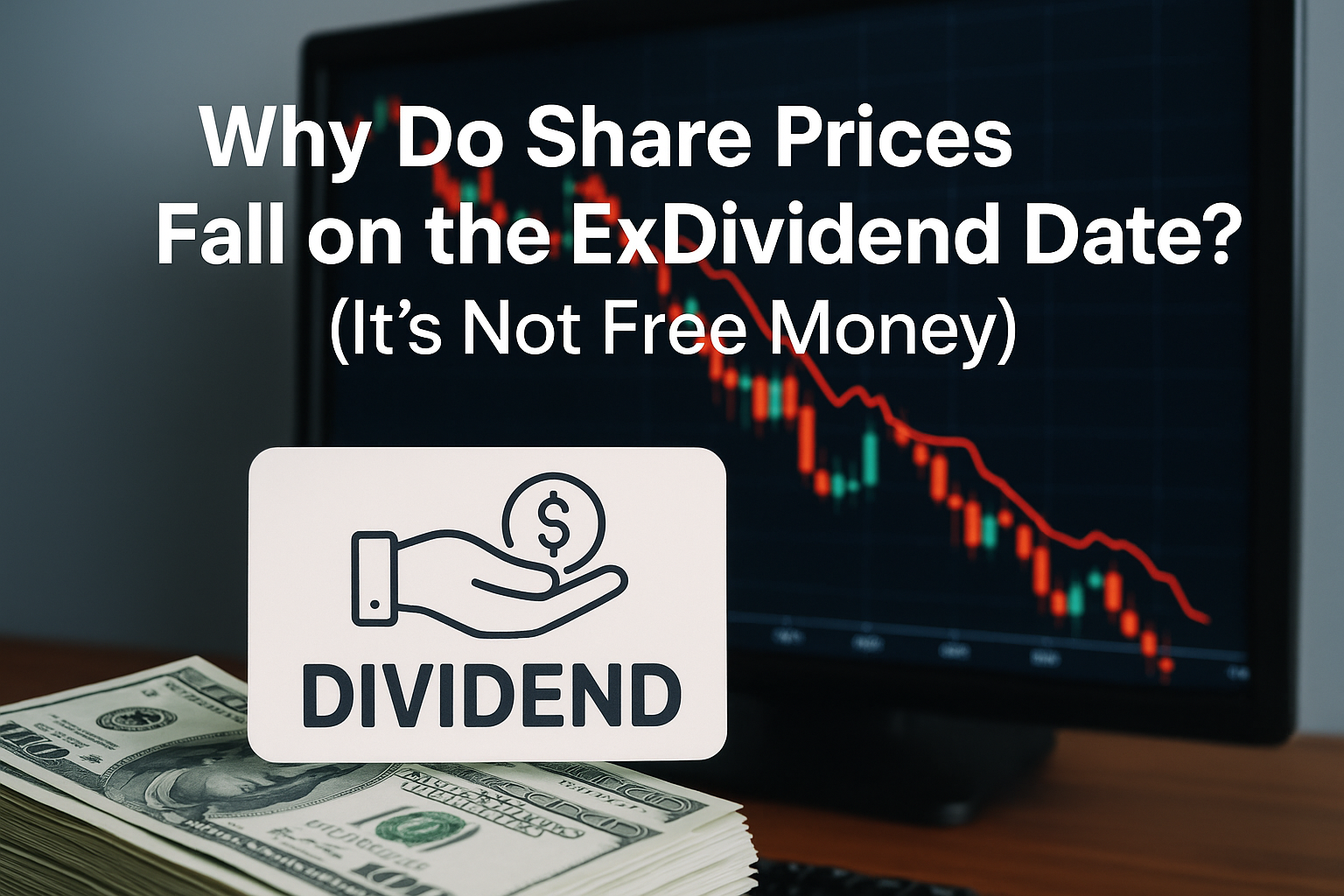
Many new investors think buying a share before the ex-dividend date is an easy way to earn free money. In reality, the share price usually falls by around the value of the dividend. This guide explains why that happens and what every investor should know.
Why Do Share Prices Fall on the Ex-Dividend Date? (And Why Dividends Aren’t Free Money)
Many new investors believe they can buy shares just before the ex-dividend date, collect the dividend and make an easy profit.
While it sounds like a simple strategy, that’s not how investing works. When a share goes ex-dividend, the share price usually adjusts lower by around the value of the dividend.
Understanding why this happens helps explain one of the most common misconceptions in investing: dividends are not free money.
What Does Ex-Dividend Mean?
When a company announces a dividend, it sets several important dates:
- Declaration Date – The company announces the dividend.
- Ex-Dividend Date – Buyers purchasing shares from this date onwards are not entitled to receive the upcoming dividend.
- Record Date – The company checks its records to confirm which shareholders are entitled to receive the dividend.
- Payment Date – The dividend is paid to eligible shareholders.
The ex-dividend date is the key date for investors because it determines whether a buyer will receive the next dividend payment.
A Simple Example
Imagine a company whose shares are trading at £10.00.
The company announces a dividend of 20p per share.
If you buy the shares before the ex-dividend date, you will receive the 20p dividend.
If you buy the shares on or after the ex-dividend date, you will not receive it.
Because the new buyer is no longer entitled to the dividend, the market typically adjusts the share price to around £9.80.
This is the theoretical ex-dividend adjustment.
Why Does the Share Price Fall?
The reason is straightforward.
When a company pays a dividend, cash leaves the business and is distributed to shareholders. The company now has slightly fewer assets than it did before the payment.
Since each share represents ownership of that company, the market adjusts the share price to reflect the lower value of the business.
This is why dividends are not “free money”. If you receive a 20p dividend but the share price falls by roughly 20p, you have simply received part of your investment return as cash rather than gaining extra value.
Before taxes and dealing costs, your overall wealth is broadly unchanged.
Why Doesn’t the Share Price Always Fall by Exactly the Dividend?
The dividend adjustment is only one factor affecting a share price.
Stock markets constantly react to company news, economic conditions, investor sentiment and wider market movements.
As a result, a share going ex-dividend may:
- Fall by almost exactly the dividend amount.
- Fall by less than the dividend if demand for the shares is strong.
- Fall by more than the dividend if negative news affects the company or wider market.
- Rise if positive news outweighs the expected dividend adjustment.
The underlying principle remains the same, but the market is always pricing many factors at once.
Frequently Asked Questions
Can you make money by buying shares just before the ex-dividend date?
Not as a guaranteed strategy. Although you will receive the dividend, the share price typically adjusts lower by around the same amount on the ex-dividend date. Once dealing costs, taxes and normal market movements are considered, there is no reliable profit simply from buying before the dividend.
Does every share fall by exactly the dividend amount?
No. The theoretical adjustment is equal to the dividend, but real-world prices are influenced by investor sentiment, company announcements and wider market conditions. A share may fall by more, less, or even rise on the day.
Why do investors still like dividend shares?
Many investors choose dividend-paying companies because dividends can provide regular income and can be reinvested to buy more shares. Over long periods, reinvested dividends can make a significant contribution to total investment returns.
The Bottom Line
When a share goes ex-dividend, the price usually falls because new buyers are no longer entitled to the upcoming dividend and the company is distributing part of its cash to existing shareholders.
The key lesson is simple: dividends are not free money.
A dividend is one part of an investor’s total return. It changes the form of your investment by converting some of the company’s value into cash, but it does not automatically increase your wealth.
Understanding this helps investors avoid one of the most common mistakes in dividend investing: assuming that buying just before the ex-dividend date creates an easy, risk-free profit.
Key Takeaway: A dividend is a distribution of a company’s value to shareholders, not a bonus payment. That is why share prices usually adjust lower when a stock goes ex-dividend.