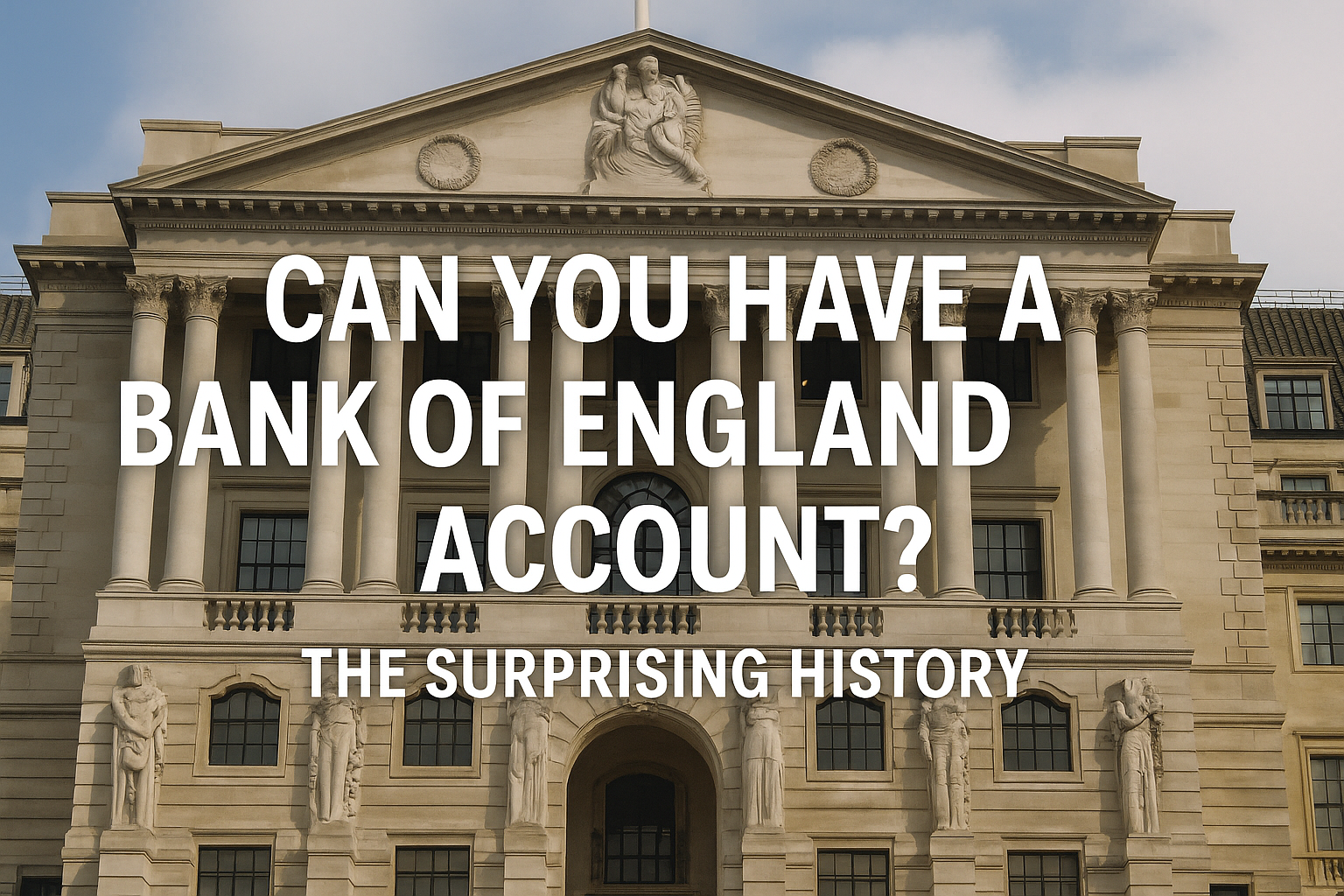
Can You Have a Bank of England Account? The Surprising History
Can you have a Bank of England bank account? The answer today is no, but it wasn’t always that way. Discover how the Bank evolved from a privately owned bank serving the public into the UK’s central bank.
Why Is It Called the Bank of England — and Could You Have an Account There?
The name Bank of England sounds as though it should be the ultimate British high-street bank.
So here’s an interesting question:
Could you actually have a bank account with the Bank of England?
The answer today is no — at least not as an ordinary member of the public.
But the story is much more interesting than that.
In fact, members of the public and private businesses really could have accounts with the Bank of England in the past.
And there is an even bigger twist:
For most of its first 250 years, the Bank of England was privately owned.
Understanding that history explains how a private bank founded in 1694 eventually became the UK’s central bank.
Why Is It Called the Bank of England?
The Bank of England was founded in 1694, during the Nine Years’ War against France.
The English Government needed to raise a substantial amount of money to help finance the war.
A group of investors provided a loan of £1.2 million to the Government. In return, they were granted a Royal Charter to establish the Governor and Company of the Bank of England.
The name was therefore fairly literal.
It was a bank established in England, with a particularly important relationship with the Government.
Its original purpose was to help finance the Government and act as its banker.
But it wasn’t exclusively a government institution.
You Could Actually Bank with the Bank of England
This is one of the most surprising parts of the story.
For much of its history, the Bank was not purely a central bank in the modern sense.
Members of the public and private businesses could have accounts there.
The Bank of England’s own archive records customer accounts dating back to its foundation in 1694, including private accounts and accounts belonging to businesses and other organisations.
The Bank also developed branches outside London.
So if you had lived in the right circumstances at the right time, the answer to:
“Can I have a Bank of England bank account?”
would once have been yes.
The Bank of England Was Originally a Private Company
There’s another piece of history that is often overlooked.
When the Bank was created, it wasn’t owned by the British Government.
It was a private bank with shareholders.
The original investors put money into the Bank through a £1.2 million loan to the Government. In return, they received Bank Stock — essentially a financial ownership interest in the newly established Bank of England.
In other words, these investors were not simply lending money to an ordinary bank. Their investment gave them a stake in the Bank itself. The stock could be transferred, its holders could receive dividends, and qualifying shareholders had certain rights to participate in the Bank’s governance.
More than 1,200 people subscribed to the original £1.2 million, with individual investments ranging from relatively modest sums to much larger amounts.
This is important because the Bank of England was therefore not originally a government-owned institution. It was established as a privately owned bank whose shareholders provided the capital that helped finance the Government.
That makes the Bank’s early history very different from the public institution we know today.
How Did a Private Bank Become a Central Bank?
This transformation happened gradually.
During the 18th and 19th centuries, the Bank of England’s relationship with the Government became increasingly important, while its role within the wider banking system continued to grow.
By the 19th century, the Bank was taking on responsibilities that we would now associate with a central bank. Its role in the financial system and in maintaining financial stability continued to expand.
Although the Bank remained privately owned, its role was steadily changing. It was becoming less like an ordinary commercial bank and more like the institution we recognise today.
Then came the decisive change: nationalisation in 1946.
1946: The Bank of England Is Nationalised
After the Second World War, the Labour Government brought the Bank of England into public ownership.
The Bank of England Act 1946 transferred the Bank’s privately held capital stock to the Treasury.
The Act received Royal Assent on 14 February 1946, and the nationalisation took effect on 1 March 1946.
At the time, the Bank had around 17,000 shareholders.
The Government compensated those shareholders with government stock in exchange for their Bank of England stock.
This was the moment when the Bank formally moved from private ownership into public ownership.
It remains publicly owned today. The Bank’s capital is held by the Treasury Solicitor on behalf of HM Treasury.
Interestingly, nationalisation did not erase the institution’s historic identity. The Bank continued as “The Governor and Company of the Bank of England” under its Royal Charter.
So When Did Ordinary People Stop Banking There?
The transformation didn’t happen overnight.
As Britain’s commercial banking system developed, ordinary retail banking increasingly became the job of commercial banks.
The Bank of England gradually withdrew from private banking while concentrating on its role at the centre of the financial system.
Its policy between 1924 and 1964 was to withdraw from private business, resulting in a substantial reduction in personal and other private accounts.
Eventually, only a small number of personal banking relationships remained.
In 2015, the Bank announced that it would withdraw from its remaining personal banking services. Those remaining accounts were closed by 2017.
So the statement:
“You can’t have a Bank of England account.”
is correct today.
But it wasn’t true for much of the Bank’s history.
What Does the Bank of England Do Today?
Today, the Bank of England is the central bank of the United Kingdom.
It isn’t competing with Barclays, Lloyds, HSBC or NatWest for your current account.
Its responsibilities include monetary policy, financial stability, banking supervision and important parts of the UK’s financial infrastructure.
It also issues Bank of England banknotes.
There are currently four denominations:
- £5
- £10
- £20
- £50
But even the banknotes have an interesting legal quirk.
Are Bank of England Notes Legal Tender Everywhere in Britain?
Not technically.
Bank of England notes are legal tender in England and Wales.
In Scotland and Northern Ireland, Bank of England notes are not legal tender.
Scottish and Northern Irish banks are authorised to issue their own banknotes under a regulatory framework overseen by the Bank of England.
This doesn’t mean Bank of England notes cannot be used in Scotland or Northern Ireland. They are widely accepted.
It simply illustrates that “legal tender” has a specific legal meaning and doesn’t mean exactly the same thing as “a form of money that shops commonly accept.”
Your Bank and the Bank of England
So, if you can’t have an account with the Bank of England, where does it fit into your everyday banking?
Let’s say you have £10,000 in your current account.
That money is held with your commercial bank, not in a personal account at the Bank of England. Your bank, however, may hold reserves at the Bank of England.
These reserves are an important part of the UK’s banking system. They can serve several purposes:
- Settling payments between banks: When payments move between customers of different banks, banks need to settle their obligations to one another. Central bank reserves provide a form of central bank money that eligible institutions can use for settlement.
- Providing liquidity: Banks need money that is immediately available to meet their payment obligations. Reserves are highly liquid and can be used without first having to sell another asset.
- Helping implement interest-rate policy: The Bank of England pays Bank Rate on reserves. This is an important part of how changes in Bank Rate influence interest rates throughout the financial system, including rates that affect borrowers and savers.
- Providing a very safe form of money: Reserves are a direct liability of the Bank of England. They are therefore different from money held in an ordinary commercial-bank account, which is a liability of that commercial bank.
To see why the first point matters, imagine you bank with Bank A and send £100 to someone who banks with Bank B. The banks need to settle the resulting obligation between themselves. With millions of payments taking place across the banking system, banks constantly need mechanisms for settling their positions with one another.
Bank of England reserves are an important part of the infrastructure that allows this to happen safely and efficiently.
So although you don’t have a personal account at the Bank of England, your bank can have a relationship with it that is fundamental to how the banking system works.
You don’t bank with the Bank of England — but your bank may.
And that is why the Bank of England can be incredibly important to your finances even though you will probably never have an account with it.
What About the Digital Pound?
There is one modern development that could make the Bank of England’s relationship with the public interesting again: the proposed digital pound.
The Bank of England and HM Treasury are exploring the possibility of introducing a digital form of money issued by the Bank of England for use by households and businesses.
However, a digital pound would not simply mean giving everyone a Bank of England current account. Under the proposed model, people would use digital wallets provided by private companies rather than opening ordinary bank accounts directly with the Bank of England.
No decision has yet been made to introduce a digital pound.
So for now, the answer remains simple: you cannot open a normal personal bank account with the Bank of England.
From Private Bank to the UK’s Central Bank
The history of the Bank of England is therefore far more complicated — and fascinating — than its name initially suggests.
1694
The Bank of England is founded to help the Government raise money for war against France.
1694–1946
The Bank remains privately owned, with shareholders who own Bank stock.
For centuries
Private individuals and businesses can hold accounts with the Bank.
19th century
The Bank increasingly takes on the characteristics and responsibilities of a central bank.
1924–1964
The Bank progressively withdraws from private banking.
1946
The Bank of England is nationalised and brought into public ownership.
1997
The Government gives the Bank operational independence over monetary policy, while it remains publicly owned.
2015–2017
The Bank withdraws from and closes its remaining personal banking accounts.
Today
The Bank of England is the UK’s central bank and is wholly owned by the UK Government, with its capital held on behalf of HM Treasury.
Disclaimer
This article is provided for general information and educational purposes only and does not constitute financial, legal, investment or professional advice. Information about the Bank of England, banking services, financial regulation and proposed changes such as a digital pound can change over time. While we aim to keep this article accurate and up to date, readers should check the latest information from the Bank of England, HM Treasury or other official sources before relying on it for financial or legal decisions.
The Ultimate Twist
The Bank of England began life as a privately owned bank serving both the Government and private customers.
Over more than three centuries, it evolved into the publicly owned central bank that sits at the heart of the UK’s financial system.
So while you can no longer open a normal personal current account with the Bank of England, the Bank’s influence reaches into almost every part of modern financial life.
It influences interest rates.
It helps maintain financial stability.
It provides important infrastructure for the banking system.
It issues Bank of England banknotes.
And your commercial bank can hold reserves with it.
So perhaps the simplest way to put it is:
You don’t bank with the Bank of England — but your bank does.
And that’s the remarkable story behind a name that has survived since 1694.