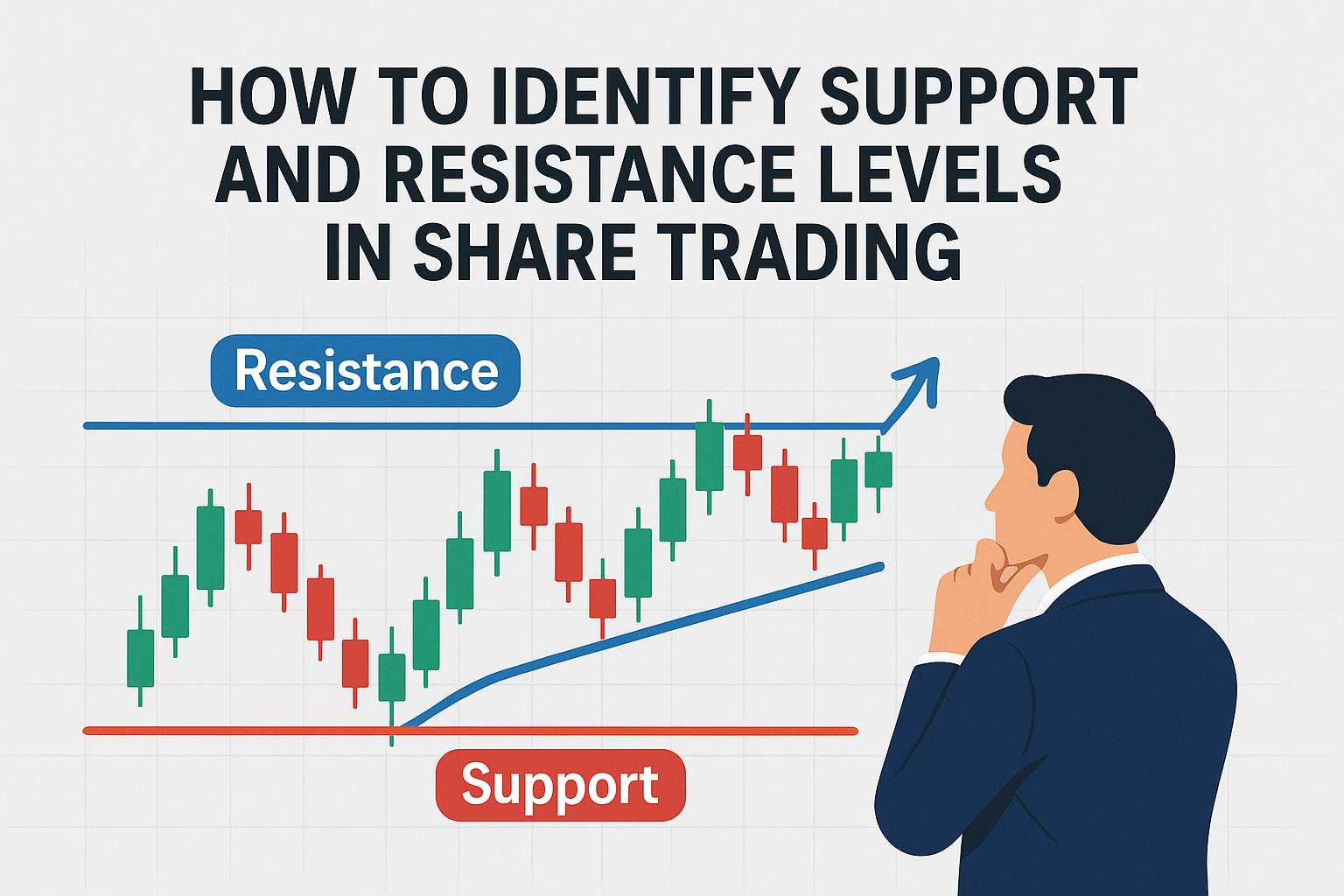
How to Identify Support and Resistance Levels in Share Trading
Support and resistance levels help traders identify important price areas where shares may pause, reverse, or continue their trend. This guide explains how these levels work and how to use them effectively.
Understanding Support and Resistance Levels in Share Trading
Support and resistance levels are among the most widely used concepts in share trading. They help traders identify important price areas where a share may slow down, reverse direction, or continue its existing trend.
Although these levels cannot predict future price movements with certainty, they provide a useful framework for understanding market behaviour and making more disciplined trading decisions.
What Is Support?
Support is a price area where buying interest tends to increase as a share falls. When the price approaches this zone, buyers may step in and reduce selling pressure, making it more difficult for the share price to continue lower.
Support does not guarantee that a price will rise. Instead, it represents an area where demand has previously been strong enough to slow or stop a decline.
What Is Resistance?
Resistance is a price area where selling pressure tends to increase as a share rises. When the price approaches this zone, sellers may become more active, making it harder for the share price to continue moving higher.
Like support, resistance is not an exact point or a guaranteed reversal level. It highlights an area where the market has previously struggled to move beyond.
Why Support and Resistance Levels Matter
Understanding these levels can help traders:
- Identify potential buying and selling areas.
- Set realistic profit targets.
- Place stop-loss levels more effectively.
- Recognise possible breakouts and trend changes.
- Improve risk management and trading discipline.
Support and Resistance Are Zones, Not Exact Prices
A common mistake among new traders is treating support and resistance as precise numbers. In reality, they are usually zones where buying or selling interest may appear.
A share price may move slightly above resistance or below support before reversing. This is why many traders look for confirmation through price action, trading volume, and the overall market trend before making decisions.
The Importance of Market Conditions
Support and resistance do not behave the same way in every market environment.
In a sideways market, prices often move between established support and resistance zones. However, during a strong uptrend, resistance levels may be broken as buyers continue to dominate. In a strong downtrend, support levels may fail as selling pressure remains high.
Considering the broader trend can help traders avoid taking positions against strong market momentum.
When Support Becomes Resistance
One of the most important principles of price movement is that support and resistance can change roles.
- When resistance is broken, it may become a new support level.
- When support fails, it may become a new resistance level.
This role reversal reflects a change in market sentiment and can provide traders with new opportunities.
How to Identify Support and Resistance Levels
Traders use several methods to identify important price zones, including:
- Previous highs and lows.
- Trendlines.
- Moving averages.
- Fibonacci retracement levels.
- Round psychological price levels.
- Areas where significant buying or selling activity has occurred.
Repeated tests of a level often show that it is important. However, a level that is tested many times may also become more vulnerable to a breakout. Traders should avoid assuming that a level will always hold and instead look for confirmation before entering a trade.
Using Support and Resistance Effectively
Support and resistance work best when combined with other forms of market information. Good trading decisions often consider:
- The overall market trend.
- Price action patterns.
- Trading volume.
- Risk management rules.
- The potential reward compared with the risk taken.
No single price level or trading method works all the time. Successful traders focus on managing risk and making decisions based on probabilities rather than certainty.
Final Thoughts
Support and resistance levels provide traders with a simple but powerful way to understand price behaviour. They help identify important areas where buying and selling pressure may influence a share’s movement.
By combining these levels with trend awareness, price action, volume, and sensible risk management, traders can develop a more structured approach to share trading.
Learning to read support and resistance is an essential first step towards understanding how markets move and how traders make informed decisions.